
Treating a Sick House

Is your home making you sick? It’s a very real phenomenon. “Sick house syndrome” (also known as “sick building syndrome”) refers to a range of nonspecific health symptoms like headaches, eye, nose or throat irritation, fatigue, dizziness, and difficulty concentrating that occupants experience while spending time in a particular building and that improve or disappear after leaving. It’s often linked to indoor environmental factors like inadequate ventilation, chemical contaminants from building materials and furnishings (volatile organic compounds, formaldehyde), biological contaminants (mold, dust mites, bacteria), and indoor combustion byproducts. Contributing conditions include poorly maintained HVAC systems, water intrusion, high humidity, and recent renovations or new furniture that off-gas. Diagnosis is typically based on symptom patterns and environmental assessment rather than a single test, and mitigation focuses on improving ventilation, controlling moisture, removing or sealing contaminant sources, and maintaining regular cleaning and HVAC maintenance.
Sick house syndrome doesn’t have to control the comfort, health, or value of your home. Here’s how you can help cure sick house syndrome—and why you need to make the process efficient, effective, and enduring.
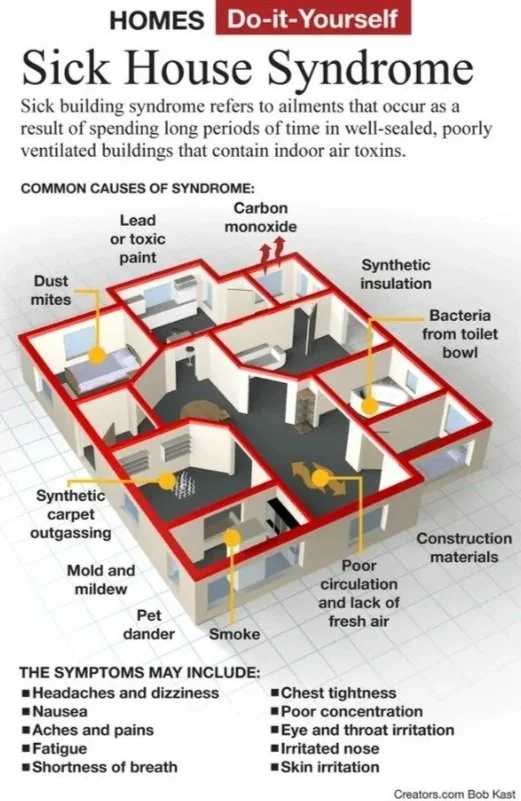
What causes sick house syndrome?
Poor ventilation trapping pollutants and moisture
Off-gassing from building materials, furnishings, paints, and adhesives
Mold and mildew from leaks, condensation, or insufficient airflow
Dust, pollen, pet dander, and particulate buildup
Combustion byproducts (gas stoves, unvented heaters) and volatile organic compounds (VOCs)
Here is a three-step cure process for sick house syndrome: assess, treat, prevent.
Comprehensive assessment — targeted diagnostics will stop guesswork, so your budget goes toward solutions that fix the real problems in your home.
On-site indoor air quality audit: arrange for professional testing for VOCs, formaldehyde, carbon monoxide, radon, humidity, and particulate matter (PM2.5).
Building envelope inspection: have a professional help you identify leaks, insulation gaps, and condensation points that promote mold.
Materials and furnishings survey: pinpoint off-gassing sources (carpets, cabinetry, paints, composite woods).
Targeted remediation and upgrades — addressing sources and improving airflow removes pollutants instead of just masking symptoms.
Source reduction: remove or replace high-emitting materials with low-VOC, formaldehyde-free alternatives; select hard-surface flooring, low-emission paints, and certified cabinetry.
Moisture control and mold remediation: repair leaks, replace water-damaged materials, install proper drainage and vapor barriers, and perform professional mold remediation where needed.
Ventilation overhaul: install or upgrade mechanical ventilation—balanced systems, energy recovery ventilators (ERVs) or heat recovery ventilators (HRVs)—to supply fresh, filtered air while conserving energy.
High-efficiency filtration: deploy whole-home HEPA filtration and MERV-rated HVAC filters appropriate for your system; add dedicated air purifiers in high-use or sensitive rooms.
Combustion safety: ensure proper ventilation or conversion of gas appliances; install/verify functioning range hoods and exhaust fans.

Sustainable prevention and healthy design — long-term strategies will help safeguard your family’s health and preserve the value and comfort of your home.
Material specifications: furnish and finish with certified low-emission products and natural fibers that resist off-gassing and microbial growth.
Smart humidity control: install humidistats, desiccant systems, or connected controls to maintain optimum indoor humidity (ideally 30–50%) to deter mold and dust mites.
Easy-clean design: select finishes and layouts that minimize dust traps and enable regular, effective cleaning.
Ongoing monitoring and maintenance plans: scheduled HVAC services, filter replacement plans, and periodic IAQ re-testing to ensure continued healthy indoor air.
Results you can expect
Measurable reductions in VOCs, PM2.5, and humidity-related risks
Lower incidence of headaches, irritation, allergy flare-ups, and respiratory symptoms
Improved comfort, energy efficiency, and indoor odor control
Increased home marketability and long-term durability of finishes
Next steps
Schedule a comprehensive indoor air quality assessment to identify the specific drivers of sick house syndrome in your home.
Receive a prioritized remediation and design plan with cost estimates and timelines.
Implement a phased upgrade path that fits your budget—target the highest-impact fixes first, then move to preventive and aesthetic improvements.
Curing sick house syndrome restores comfort, health, and confidence in your home. Contact Irwin Weiner Interiors for a practical, science-driven plan that transforms your living space into a healthy, beautiful environment.